
Introduction
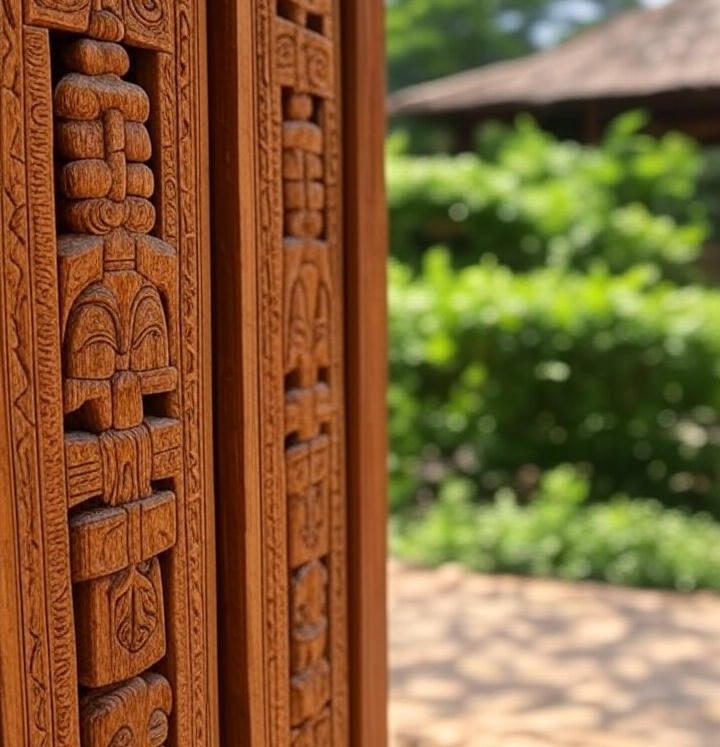
When we think of architecture, we often imagine walls, roofs, and courtyards. Yet in Yoruba tradition, even the smallest architectural detail—such as a carved wooden door—can carry the weight of history, myth, and aesthetics. For the Yoruba, a door is not merely a barrier between inside and outside. It is a canvas of memory, a storyteller, a guardian, and sometimes a spiritual mediator.
From the elaborately carved palace doors of Ekiti to the shrine panels of Ife, Yoruba wooden doors transform architecture into narrative. They remind us that the Yoruba conception of building is not limited to function but extends to art, spirituality, and philosophy.
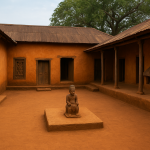
This essay explores carved doors as an essential part of Yoruba architecture. We will examine their forms, meanings, materials, and roles in both traditional compounds and royal palaces, while also situating them within the broader Yoruba aesthetics of storytelling.
The Door as Threshold and Guardian
A door is a threshold—an entry and an exit, a point of passage between spaces. In Yoruba thought, thresholds are spiritually charged. Crossing a doorway means more than moving from one room to another; it symbolizes transition from one state of being to another.
Carved doors reinforce this liminality. They are guardians, protecting inhabitants from malevolent forces while welcoming guests with beauty and artistry. They embody the Yoruba saying: ilé l’áàṣà wa—“the home is the center of our culture.” To adorn a home’s entrance is to proclaim dignity, heritage, and spiritual alignment.
Materials and Techniques
Most Yoruba carved doors are made of hardwoods like iroko or afara, chosen for durability and spiritual resonance. The carving process is itself ritualized. Master carvers pray before cutting, invoking Ògún, the deity of iron and craftsmanship, for strength and precision.
Techniques include:
- Relief carving: Figures and motifs emerge boldly from the wood surface.
- Incised lines: Geometric patterns, spirals, and symbolic marks etched into the surface.
- Polishing and staining: Enhancing durability and highlighting symbolic depth.
Each stage affirms the Yoruba belief that art is not merely aesthetic but spiritual labor.
Themes and Motifs in Carved Doors
The images carved on Yoruba doors are never random. They form a visual archive of collective memory.
- Mythological Narratives
Figures of òrìṣà (deities) appear frequently. Ogun is shown with tools, Sango with thunderbolts, Osun with flowing water, Esu with a mischievous grin. Each carving proclaims devotion and invites divine protection. - Historical Episodes
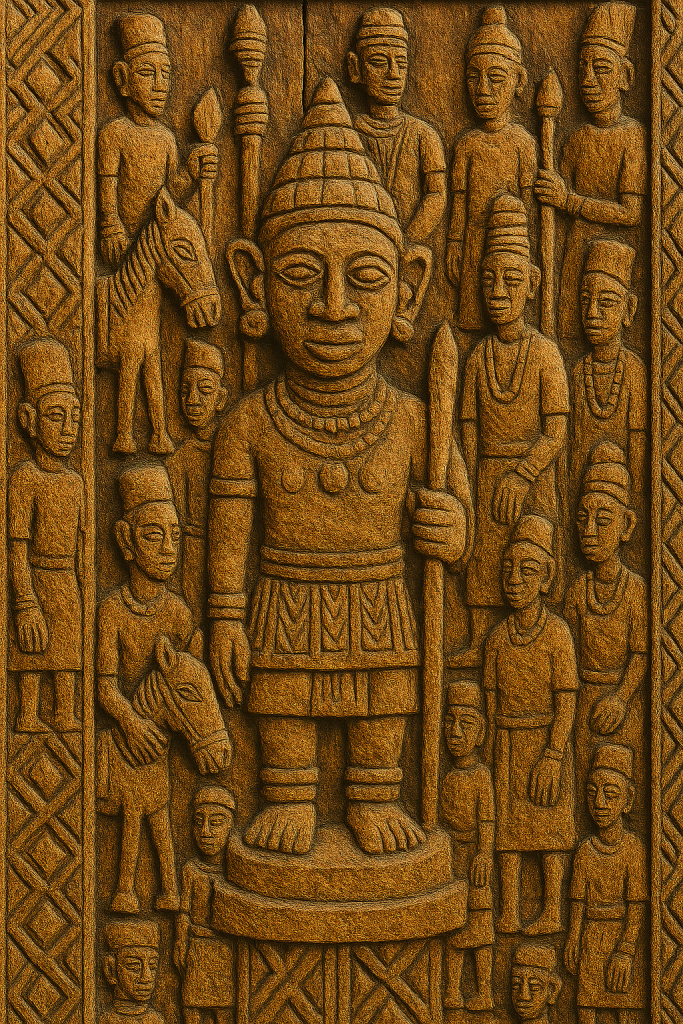
Some doors record wars, migrations, or colonial encounters. Carvings may show warriors on horseback, market scenes, or even British officials—depicting not reverence but the realities of historical contact. - Animals and Nature
Crocodiles, birds, tortoises, and snakes embody Yoruba proverbs and wisdom. For example, the tortoise (Ijapa) symbolizes cunning, while birds often represent spiritual power. - Royalty and Authority
Doors in palaces often feature images of kings, chiefs, drummers, and attendants. These affirm the legitimacy and grandeur of rulers.
Thus, every carved door is both art and archive—history etched into wood.
Carvers as Historians and Poets
Yoruba master carvers, such as Olowe of Ise, are not merely artisans. They are historians, poets, and philosophers. Olowe’s palace doors, now in museums worldwide, are masterpieces of narrative carving. They depict scenes of enthronement, drumming, dancing, and colonial officials—all in dynamic, flowing compositions.
Through these carvings, Yoruba architecture becomes literature. Just as oral poets (akíwì) recite histories in words, carvers “write” those histories in wood.
The Door in the Context of Compounds and Palaces
- In Family Compounds
Doors mark the entrances to compounds (agbo ile). A finely carved door elevates the status of the family, signaling wealth, taste, and spiritual awareness. It is a point of pride, passed down generations like heirlooms. - In Palaces
Palace doors are grander, larger, and more intricate. They are visual proclamations of power. Each courtyard in a palace may have its own carved door, narrating the functions or significance of that space. - In Shrines
Shrine doors are usually smaller but spiritually potent. They depict symbols of the òrìṣà worshipped within, transforming the door into an invocation.
Symbolism of Open and Closed Doors
The Yoruba invest symbolism in whether a door is open or closed.
- An open door suggests hospitality, truth, and transparency. It is linked to the Yoruba ethic of welcoming strangers and caring for travelers.
- A closed door implies secrecy, sacredness, or authority. Many rituals require doors to be shut to protect participants from external interference.
This symbolism resonates with proverbs such as: Eni bá mọ ibi tí ilẹ̀ ti ń bẹ, kò ní sẹ́ ẹ̀sí—“He who knows where the ground rests will not be lost.” To know when to open or close doors is to understand balance.
Colonial Encounter and Global Dispersion
Colonial contact transformed the meaning of carved doors. European collectors, missionaries, and anthropologists began acquiring them as “art objects.” Many Yoruba doors now reside in museums such as the British Museum, the Smithsonian, and the Musée du Quai Branly.
While this dispersal raises issues of cultural loss and repatriation, it also underscores the universal recognition of Yoruba artistry. What was once functional architecture is now admired as “fine art” on the global stage.
Yet in Yorubaland itself, carved doors never ceased to be living architecture. Even when plain metal doors became fashionable, some families retained wooden carved ones as links to their heritage.
Contemporary Expressions
Today, Yoruba artists and architects reimagine carved doors in modern contexts. Some incorporate them into churches and mosques, showing the adaptability of Yoruba aesthetics. Others design hotel entrances, cultural centers, and private homes with motifs inspired by traditional carvings.
In diaspora communities, Yoruba-inspired doors serve as heritage symbols, reminding African descendants of their ancestral philosophies. A carved door in Houston or London becomes a portal into memory, a connection to roots.
Carved Doors and the Yoruba Philosophy of Aesthetics
Yoruba aesthetics (ẹwà) emphasize beauty as harmony between form, meaning, and function. A carved door is beautiful not merely because it is decorative but because it embodies truth, order, and memory.
The Yoruba saying ẹwà l’ẹsin—“beauty is religion”—applies here. To carve a door beautifully is to honor the ancestors, to respect the gods, and to proclaim dignity.
The Future of Yoruba Carved Doors
The future of carved doors lies at the intersection of heritage preservation and modern creativity.
- Preservation: Traditional compounds and palaces with original doors must be protected from neglect, sale, or destruction.
- Innovation: Contemporary Yoruba architects can integrate carved motifs into new buildings, proving that tradition and modernity are not enemies but partners.
- Education: Younger generations should be taught that a door is not merely wood but culture.
If these steps are taken, carved doors will continue to “sing” their stories for centuries to come.
Conclusion
In Yoruba architecture, even the simplest feature—a door—carries profound meaning. Carved doors are thresholds that guard, narrate, and inspire. They tell myths, honor gods, proclaim power, and preserve memory.
As Yoruba compounds and palaces evolve, carved doors remind us that architecture is not only about walls and roofs but also about art, history, and spirituality. They invite us to see architecture as storytelling—where every carved tortoise, bird, or drummer whispers lessons from the past to guide the future.
To open a Yoruba carved door is to enter not just a room, but a world of wisdom.