
Introduction
In every society, architecture is more than shelter—it is memory made visible, culture rendered in space. Among the Yoruba of southwestern Nigeria, the traditional family compound, known as agbo ile, is not just a place where people live. It is where history breathes, where ancestors linger, where relationships are ordered, and where rituals unfold.
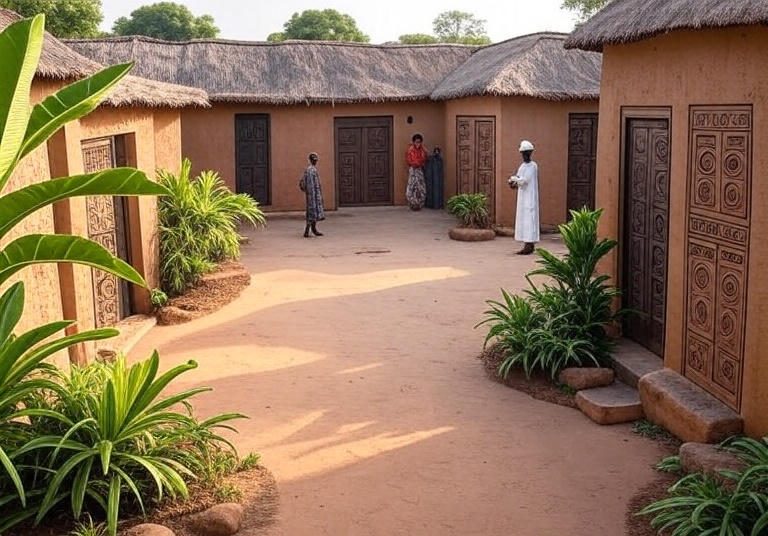
A Yoruba compound is a village within a house, a universe defined by mud walls, timber posts, courtyards, and carved wooden doors. To step inside is to encounter the philosophy of a people: their reverence for lineage, their insistence on community, and their unbroken conversation with the divine.
This essay explores the Yoruba family compound as architecture and as institution. It examines its form, function, symbolism, and evolution, situating it as both a cultural heritage and a living archive of Yoruba life.
The Spatial Logic of the Compound
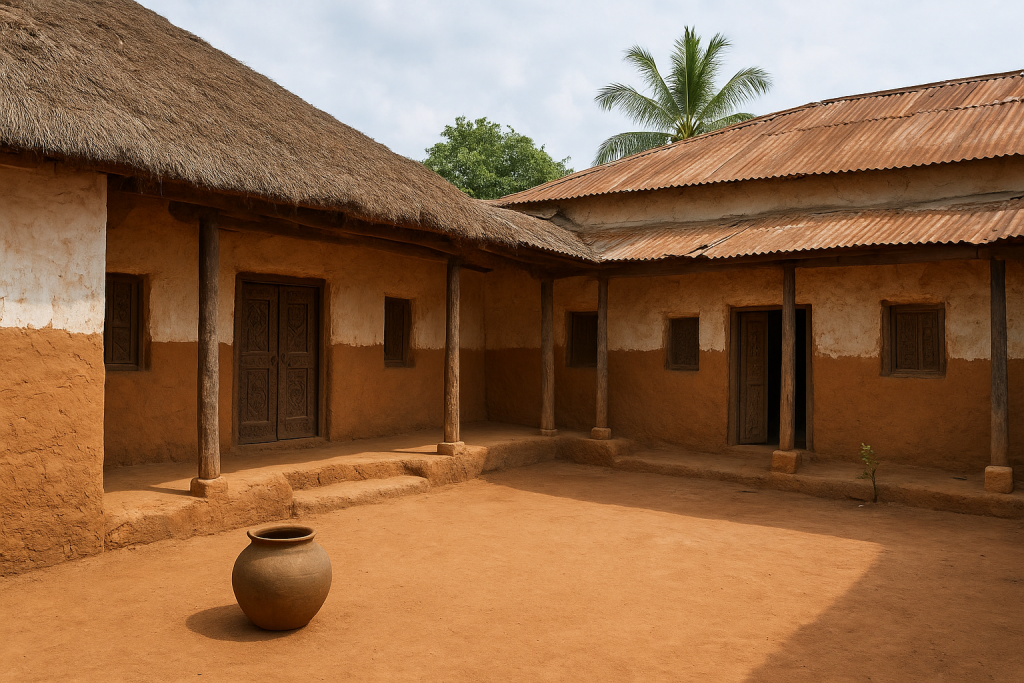
The Yoruba compound is usually a rectangular or square enclosure organized around an open courtyard. From the outside, it appears as a massive wall with only one or two entrances. Inside, however, space opens up to reveal layers of rooms and passageways, all directed toward the central courtyard.
- The Courtyard (Aarin Ile)
The heart of the compound is the courtyard. It is here that daily life unfolds—children play, women cook, men deliberate, rituals are performed, and festivals are celebrated. The courtyard is simultaneously kitchen, playground, marketplace, and parliament. - Living Quarters
Rooms line the edges of the compound, opening into the courtyard. The arrangement reflects hierarchy: the senior wife or the family head (baálẹ̀) occupies prominent rooms, while junior wives, children, and dependents are positioned accordingly. - Entrances and Thresholds
Carved doors and symbolic thresholds mark transitions between the profane and the sacred. Certain compounds incorporate shrines near entrances to protect inhabitants and announce their spiritual affiliations.
This architecture is not arbitrary—it encodes Yoruba values. Community comes before individuality, and privacy is secondary to collective belonging.
Architecture and Social Organization
Every Yoruba compound reflects a social system. It is not only a house but a diagram of kinship.
- The Extended Family
The compound houses multiple generations—grandparents, parents, children, cousins, in-laws, and sometimes clients or apprentices. This ensures continuity of lineage and the collective raising of children. - Hierarchy and Respect
Authority flows from elders to juniors. Seating in the courtyard, distribution of rooms, and even cooking arrangements reflect seniority. Respect for elders (ìbà) is inscribed in the very architecture. - Marriage and Gender Roles
Wives join their husbands’ compounds, bringing vitality but also reinforcing male-centered authority. Yet women maintain crucial spaces within the compound, particularly kitchens and ritual corners where female deities are honored. - The Baálẹ̀’s Role
The family head presides over the compound. His room may contain ancestral relics or serve as the site of family decision-making. In many ways, the compound is his domain, but his authority is balanced by the collective will of elders.
Thus, the compound is a living constitution, organizing power, gender, and age into harmonious coexistence.
The Symbolism of Mud, Wood, and Courtyards
Yoruba compounds are traditionally built with mud walls, timber posts, and thatch or later corrugated iron roofs. These materials are not merely practical but symbolic.
- Mud (Amọ̀): Represents connection to the earth (ilé), the maternal source of life. Building with mud affirms that humans come from the soil and will return to it.
- Wood (Igì): Often carved with motifs of animals, spirits, or ancestors, wood pillars act as mediators between worlds.
- Courtyard: The courtyard represents openness, truth, and visibility. Secrets may hide in rooms, but the courtyard is the stage of communal life.
Even color carries meaning. Red earth walls, chalk-white shrines, and indigo fabrics drying in courtyards speak to the Yoruba aesthetics of balance between the seen and unseen.
Ritual Life in the Compound
The compound is not secular space. It is charged with ritual significance.
- Ancestral Worship
Many compounds contain shrines (ile orisa) to ancestors or deities. Annual festivals bring family members together to pour libations and remember their lineage. - Birth and Naming Ceremonies
Newborns are introduced to the community in the courtyard. The naming ritual (isomoloruko) affirms the child’s place in lineage and destiny. - Funerals
Death rituals also unfold in the compound. The courtyard hosts drumming, dancing, and prayers that guide the deceased to the ancestral realm. - Everyday Spirituality
Even daily acts—such as sweeping the courtyard at dawn, or pouring out the first drops of palm wine—carry spiritual resonance. The compound is thus a stage where sacred and mundane are inseparable.
Compounds as Political and Economic Units
Compounds are not only residential—they are economic and political engines.
- Economics: Craftspeople like blacksmiths, weavers, and carvers often work within family compounds, making them centers of production as well as residence.
- Politics: In many towns, compounds formed the basic political unit. Heads of compounds gathered to advise chiefs, and conflicts were resolved in courtyards long before colonial courts arrived.
- Identity: A person is known by their compound. Even in urban migration, Yoruba people trace their roots by recalling their ancestral compounds.
Colonialism and the Disruption of Compound Life
Colonial urban planning and Western education reshaped Yoruba settlements. British officials saw compounds as overcrowded and “unsanitary,” introducing bungalows and detached houses that prioritized nuclear families over extended kin.
This shift weakened communal bonds. Children began to grow up away from ancestral compounds, losing touch with rituals and traditions once embedded in everyday life.
Yet the compound persisted. In both rural towns and urban quarters of Ibadan, Oyo, and Ile-Ife, compounds remain visible, though altered. Corrugated iron has replaced thatch, cement walls replace mud, and sometimes compounds rise into two-story rectangles.
Compounds in the Modern Age
Today, Yoruba compounds are caught between preservation and modernization.
- Urban Pressure: Land scarcity and urbanization threaten large compounds, leading to fragmentation.
- Diaspora Ties: Migrants in Lagos, London, or New York still identify with their ancestral compounds, sending money for renovations or returning for festivals.
- Hybrid Architecture: New compounds blend modern amenities (electricity, running water) with traditional forms. It is not unusual to find satellite dishes attached to mud-walled courtyards.
Thus, the compound adapts while retaining its essence: community, ancestry, and spirituality.
Comparative Insights: Compounds Across Africa
The Yoruba compound resonates with other African traditions—such as the Ashanti courtyard houses in Ghana, or the Swahili stone houses in East Africa. All prioritize communal living over individual privacy, a sharp contrast to Western ideals of the nuclear family.
This broader African perspective underscores that the Yoruba compound is not an architectural oddity but part of a continental philosophy of collective existence.
Preserving Courtyards of Memory
The challenge today is not merely to admire compounds as “heritage sites” but to sustain them as living spaces. Preservation must respect their dynamic use, not fossilize them into museums.
- Cultural Tourism: Well-preserved compounds in Ile-Ife and Ibadan attract visitors, showing the beauty of Yoruba domestic architecture.
- Education: Schools and universities must teach not only Western architectural history but indigenous models like the agbo ile.
- Sustainability: Mud and timber, when properly maintained, remain environmentally friendly compared to cement. Reviving their use could align with global eco-consciousness.
Conclusion
The Yoruba family compound is more than bricks and mortar. It is a living memory, a system of values, a spiritual hub, and a social contract. Within its courtyards, generations are born, raised, and remembered.
Even as modernity reshapes Yoruba life, the compound persists—sometimes neglected, sometimes renovated, always symbolic. For in the Yoruba worldview, to forget the compound is to forget the family, and to forget the family is to forget oneself.
Thus, preserving compounds is not nostalgia. It is a recognition that architecture is culture made visible, and that courtyards of memory remain vital for sustaining the Yoruba vision of community, identity, and destiny.