
Introduction
When a Yoruba elder begins a story with the familiar phrase “Alo o!”, children respond eagerly with “Aloo o!”, signaling readiness to receive wisdom. When the diviner casts the sacred palm nuts of Ifa, he does more than predict the future; he reveals patterns of destiny inscribed in the unseen. When proverbs slip effortlessly into conversation, they remind listeners that language is not merely for communication but for instruction and guidance.
Among the Yoruba, words are more than sounds. They are carriers of spirit, memory, and power. Oral traditions — including proverbs, folktales, praise poetry, and Ifa divination — form the bedrock of Yoruba cultural identity. They are archives without paper, libraries without shelves, living systems of philosophy transmitted through performance. This essay explores the roots, functions, and enduring relevance of Yoruba oral traditions, focusing especially on Ifa divination, proverbial wisdom, and storytelling.
The Sacred Power of the Word
In Yoruba thought, speech itself carries ase, the vital force that makes things happen. Words can bless, curse, heal, or destroy. To speak is to act, and oral traditions embody this philosophy.
- Proverbs (owe) encapsulate deep wisdom in brief form. They are often described as “the horse of conversation,” enabling complex ideas to travel swiftly.
- Stories and folktales transmit moral lessons, history, and social values, ensuring that children grow with an awareness of community norms.
- Ifa divination provides a cosmological map of human destiny, delivered through a vast oral corpus memorized and interpreted by trained priests.
Thus, Yoruba oral traditions are not entertainment alone but essential tools for knowledge, morality, and survival.
Ifa Divination: The Yoruba Intellectual System
Ifa is one of the most sophisticated oral systems in the world. It is both a religion and a philosophy, centered on Orunmila, the deity of wisdom and divination.
- The Corpus of Ifa
The Ifa corpus, known as Odu Ifa, contains 256 principal verses, each with numerous sub-verses, amounting to thousands of poetic narratives. These verses cover themes ranging from creation myths and historical events to moral teachings and prescriptions for human conduct. - The Role of the Babalawo
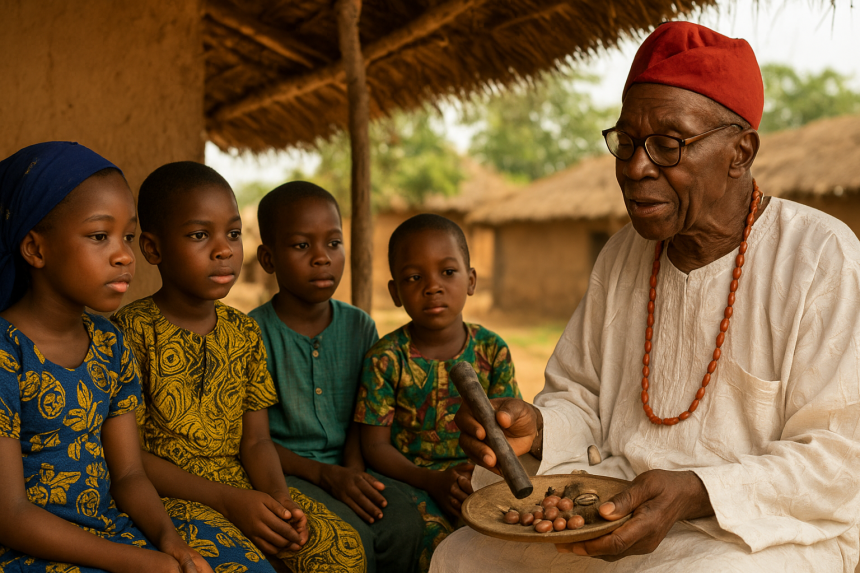
A trained diviner (babalawo) interprets these verses. Using palm nuts or a divination chain (opele), he generates patterns that correspond to specific odu. He then recites the verses, applying them to the client’s question. - Practical Relevance
Ifa guides decisions on marriage, business, health, and community disputes. It also prescribes rituals to restore balance when misfortune arises. - Orality and Memory
All of Ifa’s vast knowledge is preserved orally, requiring rigorous training and prodigious memory. Each babalawo becomes a living library, ensuring continuity across generations.
Through Ifa, the Yoruba demonstrate that oral systems can sustain complex intellectual traditions comparable to written texts.
Proverbs: The Condensed Wisdom of the Ancestors
The Yoruba say: “Owe l’esin oro, bi oro ba sonu, owe la fi nwa a” — “A proverb is the horse of words; when words are lost, proverbs are used to find them.”
Proverbs operate as linguistic keys, unlocking meaning in daily life.
- Moral Instruction: Proverbs teach values such as patience (“Sùúrù ni baba ìwà” — Patience is the father of character), hard work (“Ise logun ise” — Work is the antidote to poverty), and respect (“Bi omode ba subu, a wo iwaju; bi agbalagba ba subu, a wo eyin” — When a child falls, he looks forward; when an elder falls, he looks backward).
- Social Cohesion: Proverbs are shared references that bond communities, allowing people to communicate wisdom indirectly without offense.
- Philosophical Depth: Many proverbs encapsulate metaphysical insights about destiny (ayanmo), human nature, and the balance of life.
By condensing complex truths into memorable forms, proverbs ensure that even the illiterate carry philosophy in their tongues.
Storytelling: Folklore as Living Archive
Storytelling among the Yoruba is both education and entertainment. Folktales, known as alo apagbe, feature animals, tricksters, and mythical beings that dramatize human dilemmas.
- The Trickster Tortoise (Ijapa)
Tortoise tales are popular for teaching lessons about greed, cunning, and consequences. Despite his cleverness, tortoise often suffers downfall, reminding listeners that dishonesty has limits. - Animal Stories
Folktales featuring animals like the dog, hare, or bird highlight human virtues and vices, making moral lessons accessible to children. - Mythic Narratives
Stories about deities (orisa) preserve cosmology, explaining creation, natural phenomena, and the relationship between humans and the divine. - Performance and Participation
Storytelling is interactive. Audiences respond with choruses, riddles, or clapping, making it a communal experience rather than a passive one.
In this way, storytelling ensures that memory is not confined to books but woven into daily life.
Praise Poetry and Oral Performance
Another vital dimension of Yoruba orature is oriki — praise poetry. Every individual, family, town, and even profession has its oriki, a lyrical lineage that celebrates achievements, recalls history, and inspires courage.
Oriki are recited during festivals, ceremonies, or personal moments of motivation. For example, a Yoruba child scolded for laziness might be reminded of his ancestors’ bravery through oriki, inspiring him to live up to his heritage.
Oriki demonstrates how oral tradition sustains identity, ensuring that no one forgets where they come from.
Challenges in the Contemporary Era
Despite their resilience, Yoruba oral traditions face challenges in the modern world.
- Language Decline: Younger generations increasingly prioritize English, neglecting Yoruba language fluency. Without the mother tongue, oral traditions lose their vibrancy.
- Globalization and Media: Television, social media, and Western pop culture compete with traditional storytelling.
- Religious Pressures: Some see Ifa divination and oriki as incompatible with Christianity or Islam, leading to rejection of traditional practices.
- Urbanization: In fast-paced urban life, time for evening folktales around the hearth is diminishing.
These pressures threaten continuity unless deliberate preservation efforts are made.
Revival and Modern Adaptations
Yet Yoruba oral traditions are proving resilient.
- Literary Transcriptions: Scholars like Wande Abimbola have documented Ifa verses, ensuring preservation in written form.
- Media and Music: Nigerian musicians such as Ayinla Omowura and contemporary hip-hop artists weave proverbs and oriki into their lyrics.
- Education and Festivals: Schools and cultural organizations promote Yoruba storytelling competitions and proverb recitals.
- Global Spread: In the Americas, especially among Afro-Cuban and Brazilian communities, Ifa and Yoruba oral traditions thrive in adapted forms.
Through these efforts, oral traditions continue to evolve, proving that living wisdom can survive modernity.
Oral Traditions as Philosophy of Life
Ultimately, Yoruba oral traditions are not relics but living philosophies. They teach:
- That human destiny is interconnected with the divine.
- That wisdom resides not only in books but in memory, performance, and speech.
- That identity is sustained by remembering ancestors and honoring their voices.
In a time when many cultures risk forgetting their roots, Yoruba oral traditions remind us that to preserve language and stories is to preserve life itself.
Conclusion
The voices of the ancestors speak in Yoruba oral traditions. In Ifa verses, we hear cosmology and guidance; in proverbs, we receive condensed wisdom; in folktales, we encounter morality in action; in oriki, we remember our heritage. Together, these oral forms are not just cultural practices but lifelines, binding the living to the past and projecting wisdom into the future.
To neglect them is to risk silence; to preserve them is to ensure that the ancestral voices never fade. For as long as Yoruba oral traditions are spoken, sung, and performed, the wisdom of the ancestors will continue to guide new generations through life’s unfolding journey.