Introduction
Among the Yoruba, the hand (ọwọ) is more than a tool—it is a bridge between the visible and the invisible. Through it, clay becomes a pot, wood becomes a drum, cloth becomes a tapestry, and iron becomes a symbol of power. Yoruba arts and crafts are not mere decorations; they are embodiments of history, spirituality, and social order.
This essay explores Yoruba arts and crafts as a living heritage. It examines their traditional roots, symbolic meanings, and roles in daily and ritual life, while also considering their transformations in modern Nigeria and the global art world.
The Sacred Origins of Yoruba Art
Yoruba arts and crafts are deeply entwined with religion and cosmology. In Yoruba thought, creation itself is a kind of craft: the deity Obatala molds human beings from clay, while Ogun shapes the world through iron.
- Àṣẹ (spiritual power) flows through crafted objects, turning them into vessels of divine presence.
- Artisans are priests of matter, mediating between human needs and cosmic forces.
Thus, making a drum, carving a mask, or weaving cloth is never merely technical. It is a spiritual act that sustains the community’s bond with its gods and ancestors.
Sculpture and Carving: Faces of the Divine
Carving (ọna) holds a central place in Yoruba arts.
- Ife Bronzes and Terra-cotta
Dating back to the 12th–15th centuries, the naturalistic heads of Ife demonstrate the Yoruba mastery of form. Their serene faces reflect not just physical likeness but spiritual essence. - Palace Doors and Pillars
In royal courts, elaborately carved doors and pillars narrated dynastic histories, wars, and rituals. They transformed palaces into living chronicles. - Masks and Ritual Figures
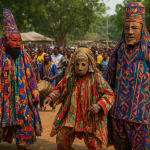
Carved masks are central in festivals such as Egungun, where ancestors return to dance among the living. The mask is not an object but a medium through which the spirit world enters the visible.
The Yoruba carver thus serves as a historian, theologian, and psychologist, compressing collective memory into wood and bronze.
Pottery: Earth Shaped into Life
Clay, in Yoruba thought, symbolizes both fragility and fertility.
- Household Pots (ikoko) serve daily needs—cooking, water storage, and food preservation.
- Ritual Vessels are offered in shrines of deities such as Yemoja (goddess of rivers) or Shango (god of thunder). Each vessel is shaped not only for utility but to honor divine presence.
- Symbolism: Just as Obatala molds clay into human form, so potters mold clay into vessels of sustenance and ritual.
In towns like Ipetumodu and Ilorin, Yoruba pottery traditions remain vibrant, often passed from mother to daughter.
Weaving and Textiles: Cloth as Identity
Among the Yoruba, cloth is language. It speaks of wealth, status, community, and spirituality.
- Aso-Oke Weaving
- Traditionally woven on narrow-strip looms, Aso-Oke is the most prestigious Yoruba textile.
- It comes in varieties such as Sanyan (beige silk), Alaari (deep red), and Etù (dark indigo).
- Worn at weddings, festivals, and funerals, Aso-Oke signifies dignity and belonging.
- Adire Dyeing
- In cities like Abeokuta, women perfected indigo dyeing techniques known as Adire.
- Using resist-dye methods, they created intricate patterns—spirals, stars, grids—that carry symbolic meanings.
- Adire is both fashionable and philosophical: its motifs narrate proverbs, cosmologies, and social values.
- Everyday and Ritual Uses
Cloth marks transitions—birth, initiation, marriage, and death. To wrap a body in Aso-Oke or Adire is to enfold it in cultural memory.
Yoruba weaving and dyeing thus transform thread and dye into visual philosophy.
Beadwork and Jewelry: Adorning the Sacred
Beads (ileke) are not mere ornaments. They are markers of power and protection.
- Royal Regalia: Yoruba kings (oba) wear crowns woven with beaded faces, symbolizing their connection to ancestors and gods.
- Priestly Insignia: Priests of Ifa or Orisha wear beads of specific colors—red and white for Shango, blue for Yemoja—signifying spiritual alignment.
- Personal Adornment: Beads worn on the neck, waist, and wrists signify status, beauty, and sometimes fertility.
Through beadwork, the Yoruba body becomes a canvas of meaning.
Metalwork: Iron and the Spirit of Ogun
Iron holds a special place in Yoruba cosmology, governed by Ogun, the deity of war, technology, and transformation.
- Tools and Weapons: Blacksmiths forge hoes, cutlasses, and swords, sustaining both agriculture and defense.
- Ritual Objects: Ogun shrines are adorned with iron tools, chains, and figures. Each piece embodies resilience and aggression.
- Currency and Exchange: Historically, iron rods and manillas (bracelet-shaped ingots) also served as currency.
The Yoruba blacksmith thus occupies a dual role: provider of tools and mediator of divine power.
Everyday Crafts: Function and Aesthetics
Yoruba artistry extends into everyday objects.
- Calabash Carving (igba): Gourds are decorated with etched patterns, used for food, storage, or ritual offerings.
- Mats and Baskets: Woven from palm fronds or reeds, they embody both utility and aesthetic pleasure.
- Furniture and Utensils: Stools, mortar-pestle sets, and headrests are often carved with decorative motifs, merging function with beauty.
In Yoruba culture, nothing is purely utilitarian; every object is also an expression of aesthetics and identity.
Arts and Crafts in Social and Ritual Life
Yoruba crafts are not separate from society—they structure it.
- Rites of Passage
At birth, children may be adorned with beads; at marriage, couples exchange cloth and crafts; at death, bodies are wrapped in textiles. - Festivals and Masquerades
Costumes, drums, masks, and beadwork animate Yoruba festivals. Without these crafts, the festivals would lose their meaning. - Social Status
Chiefs, priests, and royalty use arts and crafts to display authority. The beaded crown of an oba is not just an accessory but a statement of sovereignty.
Modern Transformations and Global Flows
Like Lagos architecture, Yoruba arts and crafts are not frozen in time. They adapt, commercialize, and circulate globally.
- Tourism and Export
Aso-Oke and Adire are now sold in boutiques across Lagos, London, and New York. Yoruba beadwork inspires fashion designers worldwide. - Contemporary Art
Artists such as Nike Davies-Okundaye have elevated Adire into global fine art. Yoruba wood carving influences contemporary sculpture. - Mass Production vs. Authenticity
Machine-made textiles and plastic beads threaten traditional craftsmanship. Yet, artisanal guilds persist, seeking to balance tradition and modern markets.
Yoruba Arts as Philosophy in Action
At their heart, Yoruba arts and crafts embody Yoruba philosophy:
- Holism: No sharp division between art, utility, and ritual.
- Communality: Crafts are often produced in workshops, guilds, and families, binding people together.
- Spirituality: Objects are charged with àṣẹ, linking material form to immaterial force.
- Continuity: Every craft repeats ancestral gestures, keeping memory alive.
Thus, Yoruba art is not simply about beauty—it is about being.
Conclusion
In the Yoruba worldview, arts and crafts are the hands of memory. They carry forward the wisdom of ancestors, embody the presence of deities, and structure the rhythms of daily and ritual life.
From the carved door to the woven cloth, from the iron hoe to the beaded crown, every crafted object speaks. It speaks of the human capacity to transform matter into meaning, to inscribe culture into clay, wood, fiber, and metal.
As Nigeria modernizes and globalizes, Yoruba arts and crafts remain a reminder that true progress is not just about glass towers and asphalt roads. It is also about honoring the hand that shapes, the tradition that guides, and the spirit that animates.
The Yoruba know that ọwọ́ la fi ńdá ilé ayé—“it is with the hand that we build the world.” To preserve their arts and crafts is not nostalgia; it is to ensure that the Yoruba way of being continues to shape the world, one carved mask, dyed cloth, and forged iron at a time.