
Introduction
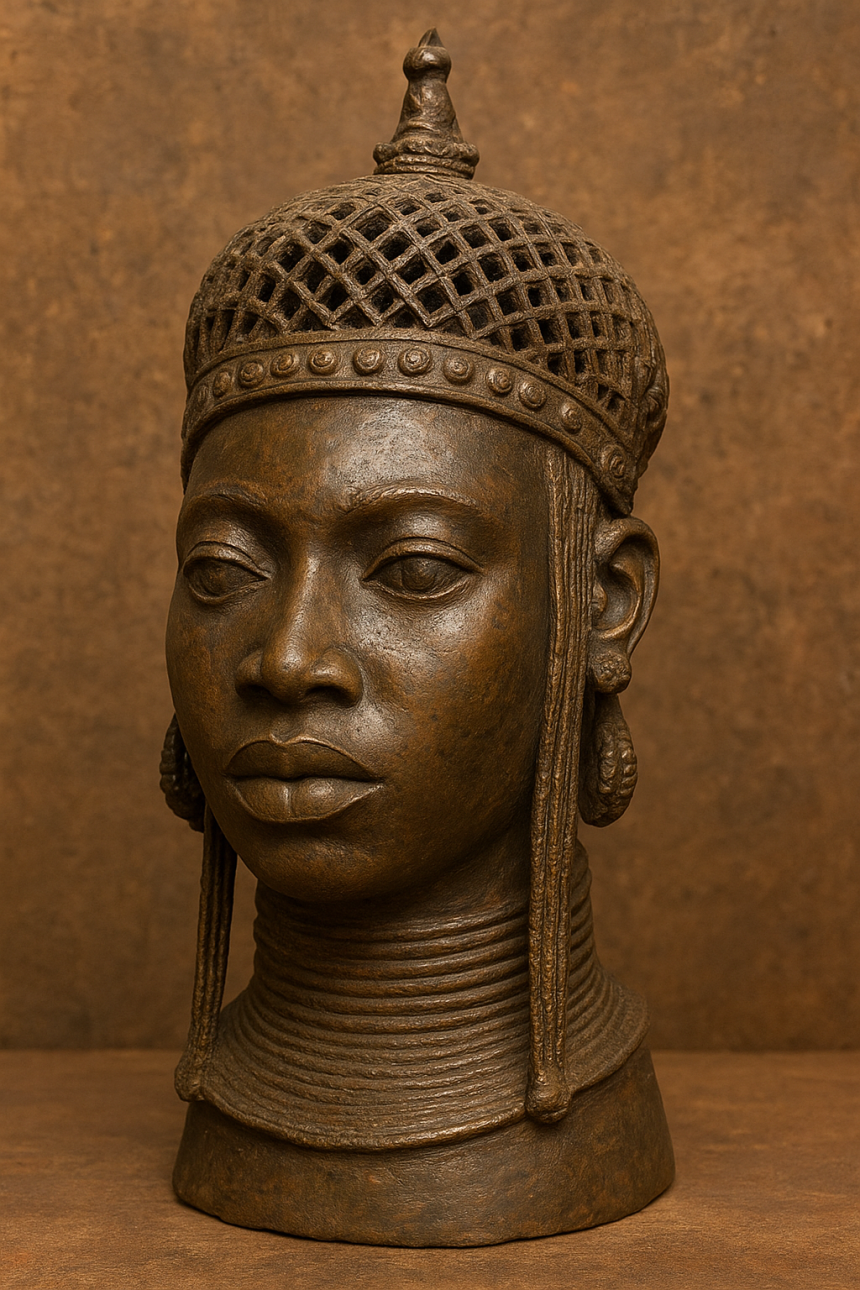
There are voices in metal, and they are not silent. When one walks into a museum hall where the bronzes of Benin rest, it is as though time itself pauses to whisper. The faces, the postures, the motifs all tell stories beyond the visible. They are echoes — echoes of a people’s belief, of ritual practices, of political order, and of resistance against erasure. The Benin Bronzes, as the world now calls them, are not simply art objects; they are ritual sculptures, forged with spiritual intent and cultural urgency. Their legacy stretches across centuries, and their meaning continues to ripple into today’s Nigeria, Africa, and even the global stage.
This essay journeys into the origins of these bronzes, their ritual significance, the trauma of their dispersal through colonial plunder, and the current debates around restitution and cultural identity. In exploring these themes, we discover that the bronzes are not relics of the past but living agents of cultural memory.
The Birth of a Bronze Culture
The Benin Kingdom, flourishing from as early as the 11th century, became renowned for its sophisticated system of governance, artistry, and trade. Central to its court culture was the use of art as a means of communication with the divine and as a record of historical and royal events.
Bronze casting in Benin was not mere craft; it was ritual duty. The royal guild of casters, known as the Igun-Eronmwon, was entrusted with producing works for the Oba (king) and the palace shrines. These pieces were often commissioned to commemorate significant events — the coronation of an Oba, a great battle, or a royal ancestor’s passing.
The process itself was sacred. Using the lost-wax casting method, casters infused each sculpture with prayers, libations, and invocations, ensuring that the bronze was more than metal — it was a vessel of spirit and memory. The sheen of the bronze captured light, symbolizing vitality, while the permanence of the metal signified endurance and eternal remembrance.
Ritual Significance and Sacred Functions
The bronzes were not made to be displayed as art in galleries. They lived within shrines, palaces, and sacred courtyards, where they functioned as intermediaries between the visible and invisible worlds.
- Commemoration of Ancestors
Many plaques and heads represented royal ancestors. By venerating them in bronze, the Oba ensured that their spirits remained close to the living court, guiding the kingdom’s affairs. - Legitimization of Authority
The bronzes were powerful symbols of political legitimacy. Each new Oba, by commissioning works in bronze, reaffirmed his place in the unbroken chain of divine kingship. - Spiritual Protection
Bronzes were also understood as protective devices. Their presence in the palace was thought to ward off malevolent forces and to ensure prosperity and stability in the kingdom. - Narrative Record
Beyond ritual, the bronzes also served as historical texts. They depict Portuguese traders, battles, royal processions, and ritual ceremonies — offering visual archives of Benin’s interactions with the world.
Thus, these bronzes must be read not merely as “art” but as spiritual, political, and historical instruments embedded deeply into Benin life.
The Trauma of Dispersal: 1897 Punitive Expedition
The story of Benin’s bronzes cannot be told without acknowledging their violent dispersal. In 1897, during the infamous British Punitive Expedition, Benin City was invaded, looted, and burned. Thousands of bronzes and other treasures were seized, many ending up in museums and private collections across Europe and America.
This event was not just the loss of objects but the disruption of a living cultural system. Shrines were desecrated, rituals interrupted, and the spiritual heart of the kingdom wounded. The bronzes became trophies of conquest, displayed as evidence of European superiority, when in truth they were proof of African genius.
For decades, Nigerians encountered their heritage only in foreign museums. The absence of these bronzes created cultural amnesia, a gap in collective memory. Generations grew up without direct access to the ritual voices embedded in bronze.
The Global Debate on Restitution
In recent years, the call for the return of the Benin Bronzes has gained momentum. Institutions such as the Humboldt Forum in Germany, the British Museum in London, and various American museums have come under pressure to repatriate these treasures.
Arguments for restitution are not only moral but also cultural and historical. These bronzes were not gifted or traded — they were stolen in the violence of conquest. Their continued possession by foreign institutions is, therefore, a continuation of colonial domination.
For Nigeria, their return is more than reclaiming objects; it is about healing a cultural wound. It is about restoring spiritual balance and reconnecting with ancestral voices. The forthcoming Edo Museum of West African Art (EMOWAA) in Benin City is envisioned as a homecoming ground where these works can once again speak to their people.
The Living Legacy in Contemporary Art
The bronzes may have been displaced, but their spirit continues to inspire. Contemporary Nigerian and African artists often draw upon the motifs, techniques, and philosophies of the Benin tradition.
- Sculptural Continuities: Artists like Peju Alatise and Victor Ehikhamenor reinterpret bronze and bronze-like forms, merging traditional aesthetics with contemporary narratives.
- Political Commentary: The bronzes inspire works that critique ongoing social and political struggles, reminding us that art remains a tool of resistance.
- Diasporic Dialogues: African diaspora artists engage the bronzes as symbols of cultural pride and as critiques of racialized museum practices in the West.
Thus, the legacy of Benin’s ritual sculptures is not confined to the past. They breathe in the works of today’s creators, proving that culture is never static.
Echoes in the Present: Why They Matter Today
Why should we continue to reflect on these bronzes in the 21st century? Because they remind us of vital truths:
- Cultural Identity: They anchor Nigerians to a heritage that is both local and global. In a world of homogenization, they affirm uniqueness.
- Resistance and Resilience: Their story embodies resilience — how a people’s cultural soul survives even after violent disruption.
- Dialogue and Healing: They create opportunities for dialogue between Africa and the world, forcing us to confront histories of injustice and imagine paths toward healing.
- Art as Memory: They remind us that art is not entertainment alone; it is memory, ritual, and resistance.
Conclusion: The Echoes Continue
The Benin bronzes are more than relics of a golden past; they are living echoes of a people’s spirit. They remind us that art can be prayer, that bronze can hold memory, and that cultural objects are not silent but speaking beings.
Their legacy is not simply in the sheen of metal but in the voices they carry — voices of ancestors, of ritual duty, of resistance, and of ongoing dialogue. As we continue to fight for their return, reinterpret their meaning, and allow them to inspire new generations, the echoes grow louder.
In those echoes, Nigeria finds both memory and vision. And in those echoes, the world is reminded that true art is never dead — it only waits for us to listen.