
The Yoruba people of southwestern Nigeria, and their diaspora across the Atlantic, have long understood that sound is not just entertainment—it is communication, spirituality, politics, and identity woven into vibrations. Among their most emblematic cultural innovations is the talking drum—the gangan or dùndún, an instrument whose voice can bend, rise, and fall to mimic human speech. In Yoruba tradition, the drum does not merely keep rhythm; it speaks, prays, praises, and protests.
The story of the talking drum is a story of language carried on wood and hide, of culture preserved in soundwaves, of authority transmitted through coded beats. This essay journeys into the world of Yoruba talking drums—exploring their history, their unique ability to replicate tone-based speech, their ritual and social roles, and their ongoing transformation in the global soundscape.
The Historical Roots of Yoruba Talking Drums
The Yoruba are one of the largest ethnic groups in West Africa, with a history stretching back to the powerful Oyo Empire (14th–19th centuries). Within this empire, the talking drum held a place of profound importance. Oyo’s political system was centralized, and its ruler, the Alaafin, maintained authority not only through military strength but through culture and symbolism. Drummers were court officials, trained to communicate messages on behalf of kings and chiefs.
Drumming was never a casual act. Each beat, each rhythm, each tonal bend carried meaning. Through drums, the Alaafin could summon warriors, send warnings to distant villages, or proclaim the greatness of his ancestors. In times of celebration, the same drums praised the bravery of rulers and immortalized their names.
The Yoruba understanding of language and sound made such sophistication possible. Yoruba is a tonal language, with words distinguished by pitch levels—high, mid, or low. The talking drum, whose pitch could be adjusted by squeezing its tension cords, was a natural companion to this linguistic system. A master drummer could reproduce speech patterns, turning wood and hide into a second tongue.
The Anatomy of the Drum
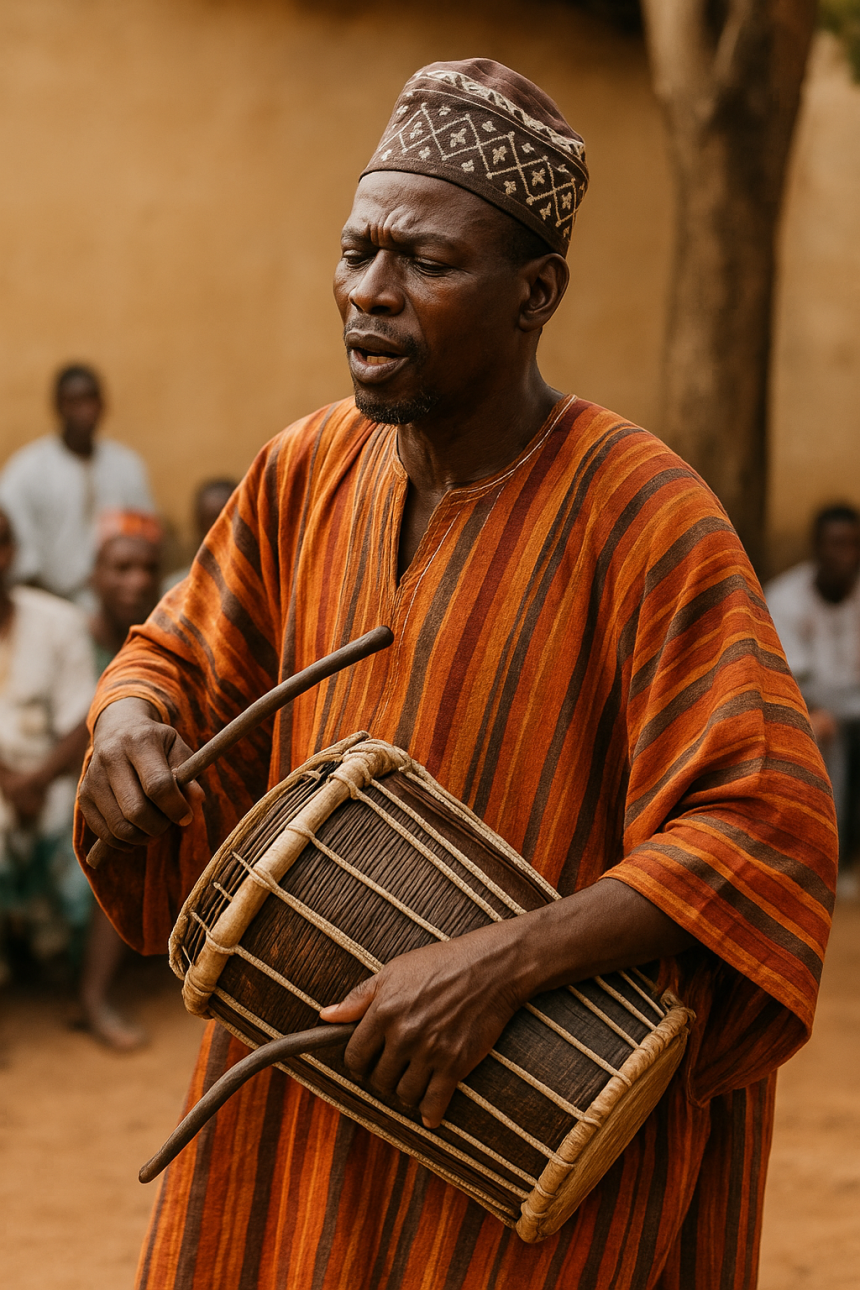
The talking drum is more than an instrument—it is an extension of the human voice. Crafted from a hollowed piece of wood, often from trees considered spiritually significant, the drum is covered with goatskin membranes at both ends. The sides are laced with tension cords that connect the skins.
By tucking the drum under one arm and squeezing the cords while striking the surface with a curved stick, the drummer alters the pitch dynamically. The drum “talks” by mimicking the tones, syllables, and rhythms of Yoruba speech. This is why Yoruba people say the drum is ọrọ ilu—the voice of the town.
Master drummers spend years perfecting their craft, not just musically but linguistically. They must know proverbs, praises, oríkì (lineage chants), and oral histories to “say” them on the drum. In this way, drummers are not mere musicians but custodians of knowledge, culture, and history.
Drums as Communication Technology
Before the advent of modern telecommunication, Yoruba drummers served as the earliest long-distance broadcasters. Drum signals could travel several miles, echoing across farmlands, forests, and rivers.
Certain rhythms were reserved for emergencies—war, fire, invasion. Others signaled festivals or royal decrees. In rural villages, drums announced market days, births, and funerals. Even lovers sent secret messages through coded drum language, understood only by the intended.
Colonial accounts often marveled at the efficiency of Yoruba drumming as communication. European administrators in the 19th century recorded how entire communities were mobilized by drum signals before officials even arrived to deliver news. What telegraphs and radios would later achieve, Yoruba drummers had already mastered centuries before—instantaneous sound communication.
Drums in Ritual and Spiritual Life
The spiritual power of Yoruba drums is as significant as their communicative role. In traditional religion, drums are not mere instruments—they are vessels of ase, the divine life force.
During rituals of the Orisa (deities), drumming summons the gods and guides participants into trance. The batá drum, for instance, is central in rituals of Sango, the god of thunder. Its polyrhythmic beats open portals between the human and the divine, drawing down spiritual presence.
The dùndún ensemble, led by the talking drum, also performs during naming ceremonies, marriages, and funerals. At each moment of life’s journey, drums voice the community’s prayers, joys, and griefs. A funeral procession without the drum’s elegiac tones feels incomplete, for it is the drum that narrates the passage of the departed into the ancestral realm.
The Drum and Social Identity
Yoruba drums are deeply tied to questions of identity—personal, familial, and communal. Through oríkì, drummers recite the genealogies of patrons, reminding them of the greatness of their ancestors. These praise poems are not simply flattery but affirmations of belonging, identity, and continuity.
In this way, the drum becomes a mirror. When the gangan calls your oríkì, you are reminded of who you are, where you come from, and the expectations placed upon you. For leaders, it is a reminder of their duties; for individuals, a source of pride and accountability.
Drummers themselves form respected guilds, often hereditary, with knowledge passed down from father to son. These drumming families hold privileged status in Yoruba society, bridging the sacred and secular worlds.
Colonial Encounters and the Resilience of the Talking Drum
The arrival of Europeans and the spread of Christianity and Islam in Yorubaland posed challenges to traditional drumming practices. Colonial authorities sometimes banned drum communication, fearing it could be used to organize resistance. Missionaries, too, discouraged drumming, associating it with “pagan” worship.
Yet the talking drum proved resilient. Its adaptability allowed it to find new homes in churches, mosques, and popular entertainment. Today, dùndún ensembles accompany Christian gospel choirs as well as Islamic festivals, showing how Yoruba culture absorbs and transforms external influences without losing its essence.
From Villages to Global Stages
In the 20th and 21st centuries, the Yoruba talking drum has transcended its local roots to become a global cultural icon. Nigerian popular music—fuji, juju, Afrobeat—incorporates talking drum patterns. Legendary musicians like King Sunny Adé and Fela Kuti used the drum not just for rhythm but for lyrical emphasis.
On the global stage, the drum has been introduced to jazz, hip hop, and world music ensembles. Master drummers now tour internationally, showcasing Yoruba culture to audiences far removed from its ancestral lands.
In the diaspora—Brazil, Cuba, Trinidad—the legacy of Yoruba drumming lives on, transformed into new rhythms like samba and rumba, yet still echoing the talking drum’s ancestral voice.
The Philosophy of Sound
Beyond technique and performance, the talking drum embodies a Yoruba philosophy of sound. For the Yoruba, language is not only about semantics but about tone, vibration, and resonance. The talking drum teaches that communication is multi-layered—what is said is as important as how it is voiced.
The drum also affirms the Yoruba worldview of interconnectedness. Sound travels, touches, and binds communities. To strike the drum is to participate in an exchange of energy, memory, and spirit.
Challenges in the Modern Era
Despite its global popularity, the talking drum faces challenges at home. Urbanization and digital culture have shifted attention away from traditional practices. Many Yoruba youths are more familiar with Western instruments and beats than with their ancestral drum language.
There is also the danger of commercialization—where the drum is reduced to a tourist attraction rather than a living vessel of culture. Preserving the depth of its meanings requires intentional cultural education, investment in drumming guilds, and integration into formal curricula.
Conclusion: The Drum Still Speaks
The Yoruba talking drum is more than an artifact of the past. It is a living technology of communication, spirituality, and identity. In every beat, it carries centuries of wisdom, reminding us that sound is not only for entertainment but for storytelling, community, and transcendence.
As Yoruba communities continue to adapt to modern realities, the drum’s role may evolve, but its essence endures. The drum still speaks, and as long as it speaks, the world will continue to hear the voice of Yoruba culture—resonant, adaptive, and eternal.